
Coffee Stack
Rollic GamesRacing
4.54.68K Reviews
- Version
- 48.0.3
- Installs
- 50.00M
- Age Rating
- Everyone
Screenshots





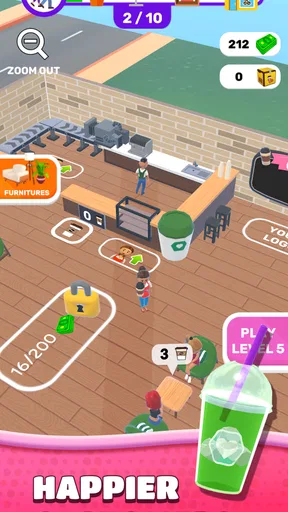


Our Review of Coffee Stack
 Analysis by Appyee
I found Coffee Stack easy to understand within a few seconds: move through a short racing course, collect coffee cups, stack them, and turn the finished run into extra cash for upgrades. That simple loop is the reason I kept returning to it. It does not ask me to learn a complicated control system or memorize a large set of rules before I can enjoy a round.
At the same time, its simplicity is more specific than it first appears. This is not a traditional racing game built around cars, lap times, or detailed vehicle tuning. It is a light, obstacle-focused coffee game from Rollic Games, designed around quick decisions and a satisfying collection rhythm. I would recommend it most to someone who wants a casual game for short breaks rather than a deep racing experience.
How Coffee Stack feels to play and who can comfortably use it
I focus on how the game’s clear, compact goal shapes the experience: it gives me a quick way to understand what a run is asking of me, while leaving room to judge whether the moving course feels comfortable on my own device. That distinction matters because an easy-to-learn game is not automatically easy for every player to follow. Next, I look at how its short-session rhythm fits into everyday use.
Readable goals and a navigation style that gets out of the way
The central objective is immediately visible during play: gather cups, keep the stack together, and guide it through the course. I never felt buried under menus or forced to study a long tutorial. That makes the game approachable for younger players and for anyone who prefers learning by doing. Its Everyone age rating also matches the friendly, uncomplicated presentation.
The strongest design choice is that the game communicates through the movement of objects. A growing stack gives me instant feedback about whether I am collecting successfully, while obstacles make the route itself the main source of information. I do not need to interpret a complicated dashboard to understand whether a run is going well. For a casual title, that clarity matters more than a large collection of statistics.
Navigation outside the course is similarly lightweight. The upgrade and reward structure gives the run a purpose without turning the game into a spreadsheet. I can play a round, see the result, and decide whether to improve my progress or start again. This straightforward flow is useful when I am tired, distracted, or only have a few minutes.
There is a trade-off, though. Players who depend on adjustable text size, high-contrast options, spoken labels, or detailed control customization may find the experience less accommodating than a game designed specifically around accessibility settings. I would not describe the interface as difficult to understand, but its ease comes mainly from simplicity rather than from a broad set of documented personalization tools.
Visual attention, motion, and motor demands
The game asks me to watch the path and react as the coffee stack moves through it. That creates a low barrier for someone who is comfortable with quick visual tracking, but it can be less comfortable for players who are sensitive to constant movement or who find fast-changing scenes tiring. The short-run format helps because I am not committed to a long race before I can stop.
Motorically, the appeal is that the game does not feel like a full racing simulator. I am not managing acceleration, braking, steering precision, and several buttons at once. The interaction is much more focused on guiding the moving collection through the course. That makes it a better fit for casual touch play than a conventional racing game with demanding controls.
Still, “simple” does not mean effortless for every player. A person with limited fine-motor control may struggle when a route requires quick changes, especially if losing cups makes a mistake feel costly. Someone using a device with a smaller screen may also find it harder to follow the stack and upcoming obstacles comfortably. I would test a few runs before deciding whether the controls feel manageable.
One useful habit is to treat the stack as the real vehicle rather than focusing only on the character or route. I found that looking slightly ahead of the cups helped me prepare for the next opening instead of reacting to the obstacle at the last moment. This is a small adjustment, but it reduces frantic movements and makes the game feel more controlled.
Why the upgrade loop works in short everyday sessions
The reward structure gives each run a clear reason to continue. Cups are not only collectibles during the race; they connect the immediate action with the longer-term goal of earning more and improving the experience. That link makes a short attempt feel worthwhile even when I do not have time for a long gaming session.
A realistic use case is a coffee break, a commute while seated, or a few minutes waiting for an appointment. I can complete a run without preparing a large strategy, then put the phone away. The game also suits players who like repetitive, calming routines: guide the stack, avoid trouble, collect what is available, and use the result to move forward.
My advice is to play in small batches rather than forcing a long session. The basic idea is enjoyable, but repetition becomes more noticeable when I continue without a break. Short sessions keep the collecting loop satisfying and make it easier to notice whether I am genuinely having fun or simply chasing the next upgrade.
How it compares with other casual racing choices
Compared with a kart racer, this game is much less about competition, vehicle identity, and complex track knowledge. A kart game is usually the better choice if I want races against opponents, drifting, weapons, or a strong sense of speed. Coffee Stack is better when I want one clear task and a playful collection mechanic.
It also differs from endless runners. Both styles can involve reacting to obstacles, but here the coffee stack gives the run a distinctive physical focus. I am not merely trying to survive for distance; I am trying to preserve and build a collection that affects the reward. That makes the moment-to-moment decisions feel more connected to the theme.
On the other hand, players seeking deep progression, competitive leaderboards, or realistic racing physics should look elsewhere. The game’s strength is its low commitment. That same quality limits how much strategic variety I can expect from it over a long period.
Practical details before installing
Coffee Stack is free to download and play, with optional in-app purchases listed at between $5.99 and $9.99 per item. I would treat those purchases as a convenience rather than part of the reason to install the game. The core appeal is the quick run-and-upgrade loop, so I would first play without spending and decide whether the repetition holds my attention.
The game was released on November 16, 2021, and its current version is 48.0.3. It supports Android 7.0 and later, which makes it available to many older Android devices. That does not guarantee identical performance on every phone, so players with aging hardware should pay attention to responsiveness and visual comfort during the first sessions.
Its scale is clear from the store audience: the game has passed 50 million installs, with an average rating of 4.5 from around 341 thousand ratings and roughly 4.7 thousand written reviews. Those figures suggest that the simple format has broad appeal, although popularity alone cannot tell me whether it matches my preferred pace or accessibility needs.
Situational access: when the design is helpful
The short, self-contained runs are the most inclusive part of the experience. I do not need to reserve a large block of time, coordinate with other players, or remember a complicated campaign. That makes it practical for people whose attention comes in brief windows or whose daily routine changes frequently.
The low-pressure theme can also work well for players who do not enjoy aggressive competition. There is no need to master a realistic vehicle or outperform a human opponent to understand the goal. The focus stays on collecting and improving, which may feel more welcoming than a racing game that immediately measures me against others.
For shared spaces, I would keep the volume low or muted if needed and rely on the visible course cues. The game’s basic objective remains understandable without treating sound as the only way to know what is happening. That said, I would still prefer clearer, explicitly described alternatives for players who cannot comfortably rely on visual feedback.
The age rating of Everyone makes it a reasonable candidate for family-friendly casual play, but parents should still consider how their child responds to repeated reward loops and optional purchases. A free game can be easy to start while still encouraging continued progression. Setting expectations before handing over the phone is more useful than assuming the rating answers every family concern.
Remaining barriers and moments of friction
The biggest limitation is the narrowness of the interaction. The game is accessible because it does little, not because it offers a large accessibility menu. Players who need remappable controls, alternative input methods, reduced motion, color adjustments, or screen-reader-friendly navigation should approach it carefully and judge the actual experience on their device.
Visual congestion can become another concern. The stack, the route, and the obstacles all compete for attention, and a player with reduced vision or difficulty tracking moving objects may need more time than the course comfortably allows. I would have liked stronger control over presentation, but I would not claim that such options are part of the experience without seeing them directly.
There is also a cognitive trade-off. The rules are simple, yet the repeated need to monitor the next section can be tiring for someone who finds rapid visual decisions difficult. The best workaround I found was to slow my own play style mentally: watch the upcoming opening, make one deliberate adjustment, then return attention to the stack. That does not remove the demand, but it makes the course less frantic.
In-app purchases can create a separate barrier for players who want a completely uninterrupted free experience. Since items can cost from $5.99 to $9.99, I would review purchase settings before letting a child play and avoid treating paid upgrades as necessary progress. The game is most appealing when the player sees improvement as something earned through repeated runs, not something that must be bought.
Who should try it, and who should skip it
I think it is a good match for casual players who enjoy collecting, simple obstacle courses, and visible progress after each attempt. It is especially suitable for someone who wants a game that can be understood immediately and played in short sessions. Fans of playful food-themed mechanics may also appreciate how the coffee stack gives the racing format its own identity.
I would skip it if my priority were realistic racing, multiplayer competition, long-term strategic depth, or extensive accessibility customization. A more traditional racer will provide richer control and stronger competition, while a carefully designed accessibility-first game may offer better support for specific motor, visual, auditory, or cognitive needs.
My most practical recommendation is to use the first few sessions as a personal accessibility check. Can I see the stack clearly? Can I make the required movements without discomfort? Does the pace feel manageable, and can I ignore optional spending without feeling blocked? Those answers are more important than the broad popularity of the title.
My inclusive verdict after playing
Coffee Stack succeeds because it reduces racing to a friendly, readable routine: move, collect, protect the stack, and improve the result. The format is approachable, free to start, suitable for Everyone, and supported by a large audience. Rollic Games has built something that works particularly well as a brief distraction rather than as a demanding racing hobby.
Its inclusive qualities are real but limited. The uncomplicated objective and short sessions help people with limited time or little interest in complex controls, while the moving visual action and lack of clearly emphasized personalization may exclude players who need more control over presentation or input. I would call it approachable, not universally accessible.
For me, the final decision comes down to expectations. If I want a quick coffee-themed collecting game that gives every run a small purpose, I would recommend trying it without spending money first. If I need deep racing, competitive challenge, or carefully documented support for a particular ability, I would choose a different option. The best reason to install it is its low commitment; the main reason to be cautious is that its simplicity cannot replace thoughtful accessibility options.
Verdict
Strengths of Coffee Stack
- Simple controls make it easy to start playing immediately.
- Short levels are well suited to quick gaming sessions.
- Coffee-themed visuals give the game a cheerful, distinctive style.
- Collecting and serving drinks creates satisfying gameplay feedback.
- Runs well on many modern phones with modest hardware requirements.
Limitations of Coffee Stack
- Gameplay can become repetitive after playing several levels.
- Some upgrades may require considerable grinding to unlock.
- Ads may interrupt the experience, especially between levels.
- Precision can feel inconsistent when obstacles are placed closely together.
- The game offers limited depth for players seeking a long-term challenge.
Other Releases by Rollic Games
View All


Similar Picks in This Category
View All
Hill Climb Racing
Fingersoft4.3

Dr. Driving
SUD Inc.4.2

Traffic Rider
skgames4.5

Asphalt 8 - Car Racing Game
Gameloft SE4.6

Race Master 3D: Car Racing
Beresnev Games4.6

Extreme Car Driving Simulator
AxesInMotion Racing4.3
Frequently Asked Questions
What is Coffee Stack, and how does the gameplay work?
Coffee Stack is a casual mobile game built around preparing and serving coffee while moving through colorful, obstacle-filled levels. You generally collect cups, coffee ingredients, and useful items, then assemble or upgrade drinks before reaching the customers. The controls are simple and usually rely on swiping or guiding your character, making the game easy to start even if you have never played a similar runner or stacking game.
Is Coffee Stack free to download and play?
Coffee Stack can generally be downloaded and played without an upfront purchase, but the free version may include advertising and optional in-app purchases. Ads can appear between levels or after certain actions, while purchases may offer bonuses, cosmetic items, or ways to progress more quickly. Before downloading, it is worth checking the store listing for the current pricing, supported devices, and available purchase options.
Does Coffee Stack require an internet connection?
The basic gameplay in Coffee Stack may work without a constant internet connection, which is convenient when you want to play during travel or in areas with limited service. However, an internet connection can be required for advertisements, rewards, cloud-related features, updates, or purchases. Offline availability may also vary between versions, so testing the game after disabling mobile data and Wi-Fi is recommended.
Are there many advertisements in Coffee Stack?
As with many free casual games, Coffee Stack may use advertisements as part of its monetization system. You can encounter optional rewarded videos for extra bonuses as well as automatic ads after selected stages or actions. The frequency may differ depending on your device, region, and version of the game. If interruptions become frustrating, check whether the app offers an official ad-removal purchase.
Is Coffee Stack suitable for children and all types of players?
Coffee Stack is designed around straightforward controls, bright visuals, and short levels, so it can appeal to children, teenagers, and adults looking for a relaxed game. Nevertheless, parents should review the age rating and privacy information because the app may contain advertising or optional purchases. Younger players may also need supervision to prevent accidental spending or interaction with unsuitable advertisements.
Play our best games!


